 Sunswap
Sunswap concentrated liquidity for earning fees within selected price ranges
Sunswap concentrated liquidity lets liquidity providers (LPs) assign capital to a chosen price range in V3 and V4 pools on TRON. A position supplies trading liquidity while the pool price remains inside those boundaries. Concentration can increase trading liquidity per unit of capital within the selected interval. The position becomes inactive if the price moves outside its range. Fee income also requires swaps that use the position's liquidity. V3 uses fixed pool fee tiers; V4 adds optional hooks that can change pool behavior. Choosing a range therefore involves the price coverage, fee setting, and management work that a position requires. Earned fees accumulate separately, so capital efficiency and compounding describe different parts of the return.
Updated on
Key takeaway: An out-of-range V3 position can still hold collectible fees earned earlier, even while its liquidity earns no new trading fees.
V3 ranges and V4 pool extensions
V3 and V4 both support bounded liquidity positions, with V4 adding pool-level programmability. V3 concentrates a position's assets between selected prices and records that position as a non-fungible token (NFT). V4 retains that range model while supporting hooks, custom accounting, and native TRX pools. V2 spreads liquidity across the full price range without individually selected boundaries. V4 extensions depend on the selected pool's configuration.
What changes when a liquidity range becomes narrower?
A narrower liquidity range concentrates the same capital into a smaller price interval, increasing liquidity within that interval while reducing the price movement that the position can accommodate.
Liquidity near the trading price
Active liquidity provides the depth that swaps encounter at the current pool price. Concentration lets a deposit support larger trades within its interval than the same capital spread across a full range. Fee income then reflects how much trading uses that liquidity and how much other active liquidity shares those fees. A narrow interval can improve fee productivity during active trading. Its closer boundaries also shorten the price movement that keeps the position active. Future trading volume and price movement determine how long that advantage remains useful.
Price coverage and management work
A wider range leaves more room for price movement before the position becomes inactive. It spreads the deposit more thinly, so the same capital contributes less concentrated liquidity. Expected price movement and the frequency of position management belong in the same decision. Moving boundaries to follow prices involves managing deposited assets and additional transactions. Time outside the range reduces the window during which the position can earn swap fees.
When does a position stop earning swap fees?
A V3 position stops earning new swap fees when the pool price leaves its selected range. V4 concentrated positions also require an in-range price for their trading liquidity to earn fees.
Range exits change the position's assets as well as its fee activity. In V3, an out-of-range position holds one token and no longer participates in swaps. The token depends on which boundary the price crosses and the pair's price convention. The position still represents a claim on its remaining assets and accrued fees. Removing liquidity redeems the remaining assets, even while the V3 position is out of range.
A price move across two selected ranges
A hypothetical V3 comparison uses two positions in the same pool, with all prices and boundaries invented and rounded for illustration. Prices use units of the quote token per base token; actual bounds follow the pool's tick grid. The narrower displayed range runs from 1.14 to 1.34, while the wider range runs from 1.04 to 1.54. The pool starts at 1.24, inside both ranges. Their displayed widths are 0.20 and 0.50 units of the quote token per base token.
If the pool price then moves to 1.44, it exceeds 1.34 by 0.10, but remains below 1.54. The narrower position becomes inactive, while the wider position remains eligible for fees from swaps that use its liquidity.
Previously earned fees may still appear on the narrower position and remain available to collect. New fee accrual stops while the price stays outside its range. The wider position's eligibility alone supplies no earnings figure, because trading volume and its active-liquidity share remain separate inputs.
Pool fee tiers and active liquidity
Pool fees specify what each swap pays, while an LP's fee income reflects the trading that uses their active position and the fee rules of the chosen pool.
V3 fixed fees
V3 pools use swap-fee tiers of 0.01%, 0.05%, 0.3%, and 1%. The pool creator selects the tier. A position joins the chosen pool and earns its applicable share when active liquidity serves trades. For the V3 TRX/USDT 0.05% pool, 1/6 of accumulated fees funds SUN buybacks and burns under the rule effective May 2, 2026. The fee tier sets the percentage of swap input that the pool charges; it specifies no annual yield.
V4 fee logic
V4 supports preset static fee tiers, custom static rates at pool creation, and hook-controlled fees. DynamicFeeHook adjusts its fee along an exponential curve that responds to trade price impact, with a 5% maximum swap-fee rate. Custom hooks can define other behavior, so the hook's identity matters alongside the displayed tier. A higher fee changes the charge per trade. Fee income still follows the volume that reaches the pool and the liquidity that participates at the traded price.
Impermanent loss and single-token exposure
Impermanent loss measures how a liquidity position's value compares with simply holding its original tokens as relative prices change. Growing earned fees can coexist with a weaker overall position value. Concentrated ranges can increase this exposure, particularly when prices leave a narrow interval and the position holds one token. Removing liquidity realizes the asset mix available at removal. Accumulated fees can offset part of the difference, but no fixed tier establishes that they will cover it.
Position settings before a deposit
Creating a V3 or V4 position requires selecting the token pair, fee setting, and lower and upper price bounds. A new pool also needs a starting exchange rate. That starting price describes the pool's initial market; the range describes where the position supplies liquidity. Keeping those values distinct prevents a range boundary from being mistaken for the price that initializes the pool.
An existing pool already has a trading price. The liquidity interface uses the current price and selected range to calculate the corresponding token amount after entry on one side. A TRON-compatible wallet handles any required token approvals and the deposit confirmation. Approval permits token spending; the liquidity transaction actually supplies the assets.
V3 and V4 issue NFT positions that record the range, fee tier, and other position parameters. The position appears in the liquidity list after the deposit succeeds. A wallet signature alone does not establish that the deposit succeeded. Position ownership concerns the claim on pool assets and fees; it does not turn that claim into a fixed token balance.
Do collected fees increase a position automatically?
Collected fees do not automatically increase V3 or V4 liquidity; compounding requires adding those assets to an existing position where supported, or creating another position. Fees first accumulate separately from principal.
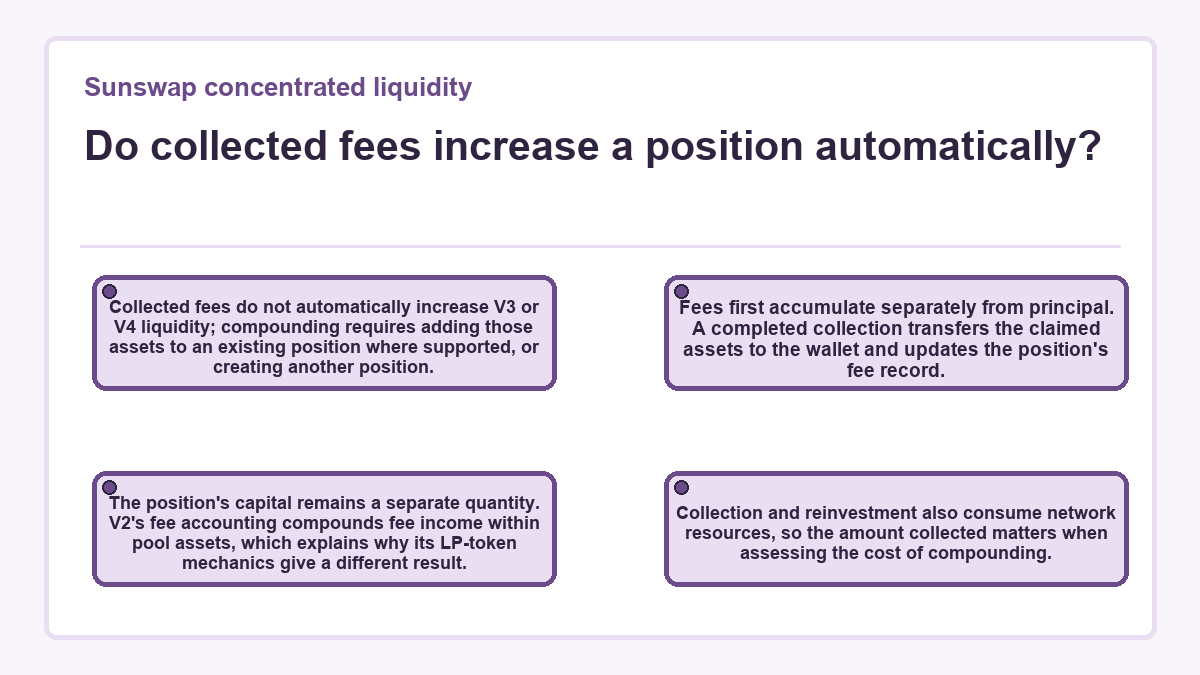
A completed collection transfers the claimed assets to the wallet and updates the position's fee record. The position's capital remains a separate quantity. V2's fee accounting compounds fee income within pool assets, which explains why its LP-token mechanics give a different result. Collection and reinvestment also consume network resources, so the amount collected matters when assessing the cost of compounding.
Tick spacing and V4 hook permissions
Ticks divide prices into indexed increments, and tick spacing restricts the grid of selectable range boundaries. V4 adds pool-specific hook rules that can affect swaps and liquidity operations.
Selectable range boundaries
In V4, successive ticks represent a 0.01% price step. Only ticks divisible by the pool's tick spacing can serve as initialized boundaries. Spacing therefore controls which lower and upper prices the pool permits. Comparing ranges also requires using the same price direction for both tokens. Reversing that convention inverts the prices and switches the interpretation of lower and upper bounds.
Automatic and interactive hooks
A V4 pool's attached hook address cannot change after creation. Automatic hooks run on supported pool operations without a separate user authorization for their logic. Interactive hooks require authorization or configured conditions for functions such as fund management. A custom hook may alter fees, accounting, or liquidity behavior, and faulty or malicious code adds risk to that pool. Automated rebalancing requires a suitable hook implementation; selecting V4 alone does not activate that strategy.
Repositioning costs and the limits of fee income
Range management incurs TRON resource costs when it requires contract transactions. Bandwidth covers transaction size, and Energy covers smart-contract computation. Available resources can cover these costs; the network burns TRX under its resource-payment rules when resources are insufficient. The expense of collecting fees or changing deployed liquidity therefore varies with the operation and the account's resources.
Comparing returns requires accounting for the initial deposit value, remaining tokens, collected and uncollected fees, and paid transaction costs over the same period. Time outside the selected range also affects the fee-earning period. Any liquidity-mining rewards require an eligible pool and the participation conditions of an active reward program.
Before you start with Sunswap concentrated liquidity
Does adding liquidity reset an existing V3 position's range?
Adding liquidity to an existing V3 position preserves its fee tier and price range. The increase operation only changes the amount supplied. Choosing different boundaries requires a position with different settings. A larger deposit into the original position therefore does not bring an out-of-range price back inside those boundaries.
Which V4 settings select a different pool rather than another position?
Changing the token types, pool fee configuration, tick spacing, or hook while configuring a V4 deposit targets a different pool. Adjusting only the price limits when creating another position can keep the same pool. Adding to an existing NFT position preserves its range, fee setting, and hook.
Why can the Collect button be inactive on a concentrated position?
The V3 and V4 interfaces disable Collect when a position has no claimable fee balance. An in-range position can still show no fees if no qualifying trading fees have accrued. Range status describes trading eligibility; the control reflects fees that are currently available to claim.
Is a tight stablecoin range protected against a lasting depeg?
A tight stablecoin range does not protect a liquidity position from a lasting depeg. If one stablecoin falls well below its peg and does not recover, a swap pool's holdings can become heavily concentrated in that token. Low volatility during the deposit period does not remove that exposure.
Are SUN incentives part of a concentrated position's swap fees?
Swap fees accrue from pool trading, while SUN incentives require separate reward-program eligibility. Providing concentrated liquidity does not make every position eligible for mining. Any active program has its own pool and staking conditions. The historical Governance Mining (V2) Stage 2 schedule ran through June 6, 2026, Singapore time.
Does Tronscan listing affect creation of a concentrated liquidity pool for a new token?
The liquidity interface requires Tronscan approval for a brand-new token that has never been listed on-chain, following submission of its contract address, name, symbol, and logo, while a token that already displays normally on Tronscan can skip that listing step.