 Sunswap
 supports token trading and liquidity provision on TRON
Sunswap is a decentralized exchange on TRON for swapping TRC20 tokens and supplying assets to liquidity pools. Universal Router's calculation service quotes paths across compatible protocol versions. Liquidity providers receive a claim on deposited pool assets and can earn fees when trades use their liquidity.
Updated on
A liquidity position represents a changing mix of pool assets, so withdrawal quantities can differ from the original deposit.
V1 to V4 pools and their uses
The pool version determines how funds support trading, even when routing brings several versions together through one entry point. V1 uses pools built around TRX and individual TRC20 tokens. Some pools remain operational, but V2, V3, and V4 are the recommended versions for new deployments. V2 supports direct pairs between TRC20 tokens through a constant-product automated market maker, or AMM. That model prices trades from the pool's reserves and allows permissionless pair creation at the protocol level.
V3 introduces concentrated liquidity, letting providers select the price range in which their assets support swaps. V4 retains concentrated liquidity and adds programmable hooks, which are contracts that customize pool behavior. Its shared pool-management contract and net-balance accounting reduce repeated transfers during complex operations. Full-range V2 liquidity avoids choosing a price band, while V3 and V4 introduce range-specific position management.
Wallet access and token permissions
A TRON-compatible wallet supplies the account and signatures needed for swaps and liquidity transactions. Connecting it identifies the selected account without authorizing a trade. For TRC20 transfers from a user's wallet through Universal Router, Permit2 handles spending permissions. Its base setup requires approving Permit2 as a spender on the token contract before the router can transfer that token. Application permissions can then specify a spender, amount, and expiration. Those permissions have a different scope from the underlying token approval, so an expiring application permission does not automatically remove the base allowance.
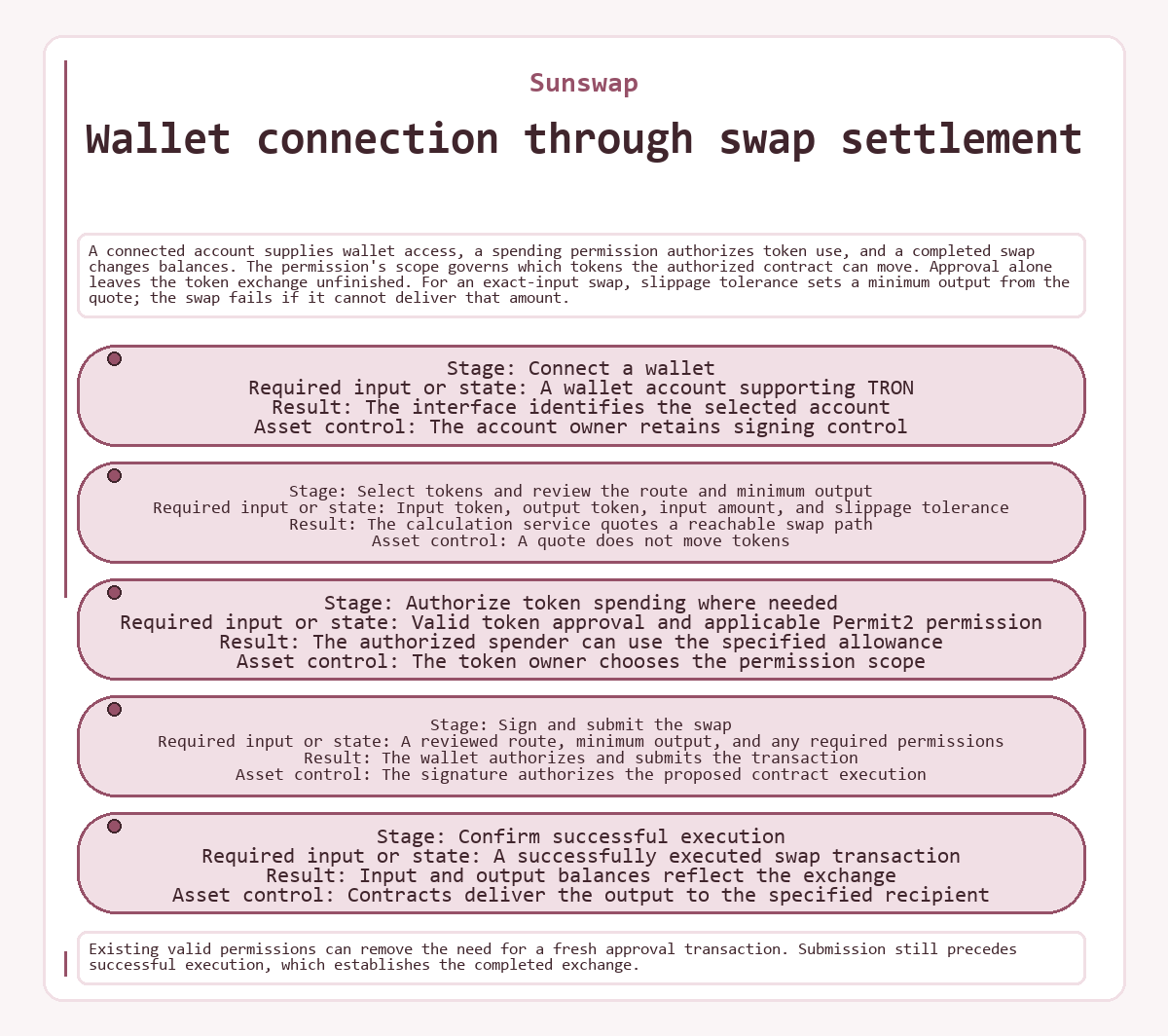
Wallet connection through swap settlement
A connected account supplies wallet access, a spending permission authorizes token use, and a completed swap changes balances. The permission's scope governs which tokens the authorized contract can move. Approval alone leaves the token exchange unfinished. For an exact-input swap, slippage tolerance sets a minimum output from the quote; the swap fails if it cannot deliver that amount.
| Stage | Required input or state | Result | Asset control |
|---|---|---|---|
| Connect a wallet | A wallet account supporting TRON | The interface identifies the selected account | The account owner retains signing control |
| Select tokens and review the route and minimum output | Input token, output token, input amount, and slippage tolerance | The calculation service quotes a reachable swap path | A quote does not move tokens |
| Authorize token spending where needed | Valid token approval and applicable Permit2 permission | The authorized spender can use the specified allowance | The token owner chooses the permission scope |
| Sign and submit the swap | A reviewed route, minimum output, and any required permissions | The wallet authorizes and submits the transaction | The signature authorizes the proposed contract execution |
| Confirm successful execution | A successfully executed swap transaction | Input and output balances reflect the exchange | Contracts deliver the output to the specified recipient |
Existing valid permissions can remove the need for a fresh approval transaction. Submission still precedes successful execution, which establishes the completed exchange.
Shared routing across different pool designs
The Universal Router calculation service searches compatible liquidity and quotes candidate paths. Universal Router can combine several pools within a single swap transaction.
A trading path may use one pool or multiple hops across supported protocols. Each hop exchanges assets through its own pool before the route reaches the selected output. The quoted output estimates what the chosen input can buy under the quoted conditions. Price impact reflects the trade's effect on pool pricing, while slippage tolerance constrains acceptable execution changes. Liquidity and pool configuration limit available routes; TRC20 compatibility alone does not establish a usable market for every token.
Pool fees and TRON resource costs
The selected pools determine trading fees, and a route containing several swaps can encounter fees at each hop. Each V2 pool swap through Universal Router charges 0.3% of its input amount. Of that same input amount, 0.25% goes to liquidity providers, and 0.05% funds SUN buyback and burn.
V3 pools use fee tiers of 0.01%, 0.05%, 0.3%, and 1%, selected when the pool is created. V4 supports those static tiers and can also use dynamic fees through a suitable hook. The fee that a V4 pool charges follows its configuration. Dynamic fees can vary as the attached hook responds to trading conditions.
TRON resource costs are separate from pool trading fees. Bandwidth covers transaction size, and Energy covers smart-contract computation. Available resources and the executed operations determine any TRX cost that falls to the account. A pool's trading percentage therefore does not describe the complete network cost of authorizing tokens, swapping, or managing liquidity.
Deposited assets and liquidity position ownership
Providing liquidity commits assets that traders can exchange through a pool. A liquidity provider, or LP, holds a claim on pool assets, with the ownership record depending on the version.
Position records
V2 pool shares
V2 issues TRC20 LP tokens representing a proportional share of the pool. Trading fees allocated to providers accumulate within the pool and contribute to the assets behind those shares. Trades also change the reserve balances, so the token quantities represented by a share can change. The LP token records ownership of that share throughout those changes.
V3 price ranges
V3 records liquidity through a non-fungible token, or NFT, position with its own range and fee tier. A V3 position earns trading fees only while the trade price remains within its selected range. Outside that range, the deposited liquidity becomes inactive and consists of a single token. Providers collect earned fees separately, so uncollected fee income and deposited liquidity remain distinct parts of the position.
Pool creation and existing deposits
The liquidity interface requires Tronscan approval of a brand-new token's listing before creating a pair for that token. In a new V2 pool, the deposited token ratio establishes the initial price. V3 and V4 require an explicit starting exchange rate when creating a pool. Adding liquidity also involves the position's range and fee parameters. An existing pool already has a price and reserve state, which govern the amounts needed when adding liquidity.
V4 also represents liquidity ownership through NFT positions. Removing liquidity returns the assets represented by the withdrawn position share. Withdrawal quantities reflect intervening trades and the position's remaining liquidity, so they can differ from the original deposit.
Fee income and incentive conditions
Trading fees arise when swaps use supplied liquidity. Additional mining rewards require a pool that qualifies under an active incentive program.
Mining schedules and veSUN
The Governance Mining (V2) design linked veSUN, obtained by locking SUN, to voting and eligible mining boosts. Its second-stage schedule covered September 15, 2021, through June 6, 2026, in Singapore time. Mining income beyond that period depends on a continuing or replacement incentive program, its eligible pools, and its staking conditions.
Exposure when prices diverge
Impermanent loss means an LP position can underperform holding the same tokens separately when their relative prices change. Trading fees may offset some of that difference, but receiving fees does not establish an overall gain. Stablecoin pools also rely on their assets retaining their pegs. A persistent depeg can leave providers with liquidity concentrated in the depegged token.
Pool analytics and account activity
Scan shows token and pair information, liquidity data, trading volume, and candlestick charts for examining pool activity. Search accepts a token name or address, and selecting a pool reveals its price trend. Recent transaction history provides account activity for reviewing liquidity and staking actions. Pool charts describe that pool's past trading; a routed swap may draw liquidity from other pools. Historical volume therefore cannot establish the depth available for the next quoted trade.
SunCurve, SunPump, and pool-specific extensions
SunCurve focuses on stablecoin liquidity, while SunPump supports meme-token launches on TRON within the wider SUN ecosystem. PSM and SUN-HTX are separate conversion mechanisms with their own supported assets and rules. Universal Router integrates SunCurve, PSM, and SUN-HTX alongside Sunswap pools through a common trading entry point. Their shared access does not make every fee structure or liquidity model interchangeable.
V4 hooks add another distinction within Sunswap itself. Developers can implement custom fees, curves, or oracle behavior through a pool's attached hook. Automatic hooks can run during swaps or liquidity changes, while interactive hooks require the relevant user authorization. A pool's hook-based features depend on what its attached hook implements.
Sunswap: questions and answers
Which wallets connect to the Sunswap V1/V1.5 interface?
The V1/V1.5 interface lists TronLink, Binance Wallet, WalletConnect, TokenPocket, Bitget Wallet, OKX Wallet, and Ledger as supported connection options. The wallet must support TRON through the chosen connection. Its connector also needs to be available in the interface being used.
Does Universal Router support exact-output swaps?
Sunswap V2 and V3 support exact-output swaps through Universal Router, while Universal Router's V1 routes support exact-input swaps only. An exact-output instruction fixes the amount to receive and sets a maximum input amount. The interface also needs to expose exact-output mode to let the user select it.
Why do V2 and V3 use WTRX?
V2 and V3 use WTRX, wrapped TRX, because their pools operate on TRC20 tokens. Wrapping represents native TRX in that token format. Universal Router supports wrapping and unwrapping as part of its asset-handling operations, while V4 also supports native TRX directly.
Are tokens in selection lists endorsed by Sunswap?
Token-list inclusion does not establish an endorsement by Sunswap. The selection lists are community driven and independently maintained, and the interface allows users to choose or add lists. A list helps locate tokens; its inclusion criteria do not establish a token's liquidity or transfer behavior.
Is an English-language interface available?
The V1/V1.5 frontend supports English, Simplified Chinese, and Traditional Chinese. Its in-app language selector changes the display language.